
Courses
At UTC Plymouth, our Sixth Form curriculum is designed to provide academic rigour, technical expertise, and industry alignment. Each course below includes details on qualifications, entry requirements, skills needed, course outline, student perspectives, and career pathways.
T Level in Design and Development for Engineering and Manufacturing
Duration: 2 Years
]Level: Level 3 (Equivalent to 3 A Levels)
Course Overview
The T Level in Design and Development for Engineering and Manufacturing is a high‑quality, two‑year technical qualification designed for learners aged 16–19 who want to pursue a career in the engineering or manufacturing sectors.
This programme provides students with a strong foundation of industry knowledge, alongside the hands-on technical skills needed to enter the workplace with confidence. The course has been developed in collaboration with employers to ensure it reflects current and future industry practice. By the end of the qualification, learners will achieve ‘threshold competence’—the essential skills and understanding required to take the first step into engineering-related roles.
Students who complete this qualification will be well-prepared to progress into:
-
Skilled employment within the engineering and manufacturing sectors
-
High-quality engineering Apprenticeships
-
Higher education programmes, such as HNCs, HNDs, or engineering degree routes
This T Level is ideal for learners who enjoy problem‑solving, practical work, innovation, and understanding how modern engineering shapes the world around us.
Progression Opportunities
The T Level provides a clear pathway into a wide range of engineering and manufacturing careers. Upon completion, learners can progress into roles such as:
-
Engineering Technician
-
Mechanical, Electrical, or Electronic Engineering roles
-
CAD/Technical Design roles
-
Manufacturing and Production Engineering
-
Maintenance Engineering
-
Mechatronics and Automation
-
Quality Control and Testing
Students may also continue into higher-level qualifications, including university degrees, degree apprenticeships, or other advanced technical training.
Assessment Structure
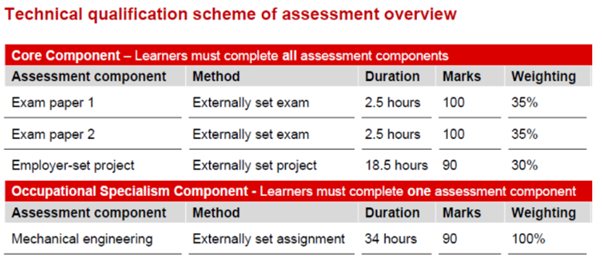
Assessment combines exams, practical application, and specialist project work:
Year 1:
-
Two Core Exams covering the essential knowledge of engineering and manufacturing
-
Employer‑Set Project (ESP) where students respond to a real-world industry brief
Year 2:
-
Occupational Specialism, allowing students to focus on a specific area of engineering design and development and demonstrate skills through substantial practical assessments
Entry Requirements
To enrol on this course, learners should have:
-
Minimum Grade 4 in GCSE English
-
Minimum Grade 4 in GCSE Maths
On completion of the T Level, students can achieve one of the following overall grades: PPP, MMM, or DDD.
What You’ll Study
Across the two years, students will develop the scientific, mathematical, and technical skills required for modern engineering. Topics include:
-
Working within the engineering and manufacturing sectors
-
Engineering and manufacturing past, present, and future
-
Engineering representations (including drawings and CAD)
-
Essential mathematics for engineering and manufacturing
-
Essential science for engineering and manufacturing
-
Materials and their properties
-
Mechanical principles
-
Electrical and electronic principles
-
Mechatronics
-
Engineering and manufacturing control systems
-
Quality management
-
Health and safety principles
-
Business, commercial, and financial awareness
-
Professional responsibilities, attitudes, and behaviours
-
Stock and asset management
-
Continuous improvement
-
Project and programme management
Students will also complete a meaningful industry placement, allowing them to develop essential workplace experience and build strong links with employers.
📢 Find Out More
For further information about the course, assessment, or how to apply, please speak to Katy Jackson
We are here to help you choose the right digital pathway for your future career.
T Level in Digital Support and Security (Cyber Security)
Duration: 2 Years
Level: Level 3 (Equivalent to 3 A Levels)
⭐ Course Overview
The T Level in Digital Support and Security (Cyber Security) is a two‑year advanced qualification designed for learners aged 16–19 who are passionate about technology, digital systems, and protecting organisations from cyber threats.
Cyber Security is one of the fastest‑growing sectors in the digital world. From safeguarding data to responding to cyber incidents, skilled professionals are in high demand across every industry—including government, finance, healthcare, engineering, education, and defence.
This T Level provides students with:
-
A strong foundation in core digital and cyber concepts
-
Hands‑on experience investigating, preventing, and responding to security risks
-
Professional behaviours and workplace skills needed for modern IT environments
-
A substantial industry placement (minimum 315 hours) with a real employer, giving learners experience of digital support, cyber awareness, or security operations
The programme blends classroom learning with practical, industry‑aligned skills—preparing students to progress confidently into an apprenticeship, employment, or further study.
🔍 What You Will Study
Students will explore a broad range of digital and cyber‑focused topics that develop both technical knowledge and real‑world skills. Areas include:
Core Digital Knowledge (Year 1)
-
Understanding the digital landscape and emerging technologies
-
How organisations use digital systems
-
Network fundamentals and infrastructure
-
Information security principles
-
Data management and regulation
-
Testing, troubleshooting, and digital problem‑solving
-
Business environment and professional behaviours
-
Creating secure digital solutions
Cyber Security & Specialist Content (Year 2)
-
Preventing cyber attacks
-
Malware, phishing, social engineering, insider threats
-
Designing and applying security measures
-
Digital Forensics
-
Investigating incidents
-
Analysing digital evidence
-
Reporting and documenting findings
-
Network and System Security
-
Firewalls, encryption, access control
-
Risk assessments and vulnerability testing
-
Cyber Policies, Compliance & Ethics
-
GDPR, legal frameworks, organisational policies
-
Supporting users and maintaining secure systems
-
Providing professional digital support
-
Monitoring and updating security tools
Students also complete a real Employer‑Set Project (ESP) where they respond to an industry scenario, demonstrate technical problem‑solving, and present professional documentation.
📝 Assessment
Year 1
-
Two Core Exams – covering digital concepts, legislation, security fundamentals, and industry practice
-
Employer‑Set Project (ESP) – a practical challenge set by industry experts
Year 2
-
Occupational Specialism (Digital Support & Cyber Security)
-
Large practical assignments
-
Realistic work‑based tasks
-
Demonstrating competence in secure digital support
Students can achieve grades: PPP, MMM, or DDD.
🎓 Entry Requirements
To join this T Level, learners need:
-
Minimum Grade 4 in GCSE English
-
Minimum Grade 4 in GCSE Maths
A passion for IT, problem‑solving, and digital technologies is strongly recommended.
🚀 Progression Opportunities
Cyber Security and digital support are rapidly expanding sectors with excellent career prospects. After completing this T Level, students can progress into:
Employment or Apprenticeships
-
IT Support Technician
-
Cyber Security Technician
-
Security Operations Centre (SOC) Analyst
-
Network Technician
-
Digital Service Technician
-
Cyber/Information Security Apprentice
-
Digital Infrastructure Support
Further & Higher Education
-
Cyber Security Degrees
-
Digital Forensics Degrees
-
Computer Science
-
Networking & Infrastructure
-
Software Engineering
-
Degree Apprenticeships
Students will graduate with strong practical skills and workplace experience, making them highly competitive for both employment and university routes.
📢 Find Out More
For further information about the course, assessment, or how to apply, please speak to Debbie Collins.
We are here to help you choose the right digital pathway for your future career.
Foundation Year: EAL Level 3 Subsidiary Diploma in Engineering Technologies
Duration: 1 Year
Level: Level 3 (Equivalent to 1 A Level)
⭐ Course Overview
The EAL Level 3 Subsidiary Diploma in Engineering Technologies is a one‑year, highly practical qualification designed for learners who aspire to build a strong foundation in engineering before progressing to higher-level study or employment.
This vocational programme is ideal for students interested in pathways such as manufacturing, aerospace, marine, mechanical engineering, CNC machining, welding, and advanced design technologies.
Learners benefit from hands-on workshop training, employer‑informed curriculum design, and direct exposure to the skills shortages identified by local engineering partners. This ensures the course aligns closely with the needs of the regional manufacturing and engineering sector.
The programme is often studied alongside GCSE English or Maths resits, enabling learners to secure essential qualifications while developing industry-ready engineering skills.
🚀 Progression Opportunities
This qualification carries UCAS tariff points equivalent to 1.5 A Levels, giving students several strong progression options:
Higher Apprenticeships
The course is an excellent stepping‑stone to advanced and higher apprenticeships in:
-
Manufacturing
-
Precision machining
-
Welding & fabrication
-
CNC programming
-
Mechanical engineering
-
Aerospace or marine engineering
Employment
The course equips students with the practical and knowledge-based skills valued by engineering employers within the local manufacturing sector.
Further Study
Students can progress onto:
-
EAL Level 3 Extended Diplomas
-
T Level in Engineering & Manufacturing
-
Further Level 3 specialist pathways
📝 Assessment
Assessment is designed to prepare students for real industry expectations and includes:
-
1 online exam (Unit 1)
-
A series of controlled knowledge tests
-
Practical assessment tasks completed in workshops and specialist facilities
🎓 Entry Requirements
-
Minimum Grade 3 in GCSE English
-
Minimum Grade 3 in GCSE Maths
Learners can achieve the following grades: Pass, Merit or Distinction.
🔍 What You’ll Study
Students will explore essential engineering principles and gain hands‑on experience in areas such as:
-
Engineering and Environmental Health & Safety
-
Computer‑Aided Design (CAD) Techniques
-
CNC Programming & CNC Machining
-
MIG/MAG Welding Techniques
-
TIG Welding
-
Advanced Turning Processes
This qualification is particularly suitable for learners who enjoy practical problem‑solving and developing technical skills in real workshop environments.
📢 Find Out More
For further information about the course, assessment, or how to apply, please speak to Katy Jackson.
We are here to help you choose the right digital pathway for your future career.
Foundation Year: EAL Level 2 Certificate and Diploma in Engineering Technologies
Duration: 1 Year
Level: Level 2 (Progression to Level 3)
⭐ Course Overview
The EAL Level 2 Certificate and Diploma in Engineering Technologies provides an excellent introduction to the engineering sector for learners who have completed Cambridge National Engineering Design or other related pre‑16 qualifications.
This course focuses heavily on practical skill development, enabling students to work confidently with tools, machinery, and engineering processes. It includes a blend of theory, workshop-based learning, and controlled assessments that mirror real industry practices.
The programme is designed to help learners strengthen their engineering skills, boost their confidence, and prepare for further specialist study at Level 3.
🚀 Progression Opportunities
Successful learners can progress onto:
-
EAL Level 3 Subsidiary Diploma in Engineering Technologies
-
T Level in Design & Development for Engineering and Manufacturing
-
Other Level 3 technical engineering routes
This foundation year is an excellent choice for learners looking to build a secure skills base before moving into more advanced engineering qualifications.
📝 Assessment
Assessment includes:
-
1 online exam covering elements from Units 1, 2, and 3
-
Controlled knowledge assessments
-
Practical workshop assessments
Students learn to work to industry standards, using real tools, processes, and engineering techniques.
🎓 Entry Requirements
-
Minimum Grade 2 in GCSE English
-
Minimum Grade 2 in GCSE Maths
Grades available: Pass, Merit or Distinction
🔍 What You’ll Study
Learners will explore a range of engineering topics designed to build knowledge and practical confidence, including:
-
Engineering Environmental Awareness
-
Engineering Techniques
-
Engineering Mathematics and Science Principles
-
Manual Turning Techniques
-
CNC Turning Techniques
-
Computer‑Aided Drawing (CAD) and technical representation
This course gives students the foundation skills required to progress into more advanced engineering pathways.
📢 Find Out More
For further information about the course, assessment, or how to apply, please speak to Katy Jackson.
We are here to help you choose the right digital pathway for your future career.
Pre‑T Level in Cyber Security
Duration: 1 Year
Level: Level 3 (Equivalent to 1 A Level)
⭐ Course Overview
The Pre‑T Level in Cyber Security is a one‑year, Level 3 qualification designed for learners who want to develop the core digital and security skills needed before progressing to the full T Level in Digital Support and Security.
This programme provides a strong introduction to cyber security principles, helping students understand how digital systems are protected, how attacks occur, and how organisations respond to security incidents. It blends theoretical knowledge with hands-on investigation, analysis, and practical problem‑solving.
The course is ideal for learners who are interested in careers in IT, networking, digital support, cyber analysis, and digital forensics — or who simply want a strong technical foundation before moving into more advanced study.
🔍 What You Will Study
Students will explore a wide range of essential cyber and digital security topics, including:
-
Preventing Cyber Attacks[Text Wrapping Break]Understanding the different types of attacks, including malware, phishing, social engineering, viruses, and insider threats, and how organisations defend against them.
-
Digital Forensics & Investigation[Text Wrapping Break]Learning how to collect, analyse, and interpret digital evidence, investigate system breaches, and document findings professionally.
-
Fundamentals of Cyber Security[Text Wrapping Break]Exploring secure system design, risk management, network security concepts, user behaviours, and the legal and ethical frameworks surrounding cyber security.
Across all units, learners develop technical troubleshooting skills, digital problem‑solving abilities, and professional behaviours essential for working in modern IT environments.
Learners can achieve the following grades: Pass, Merit, or Distinction.
📝 Assessment
Assessment is a mixture of exams and coursework to ensure learners develop both knowledge and applied skills:
-
2 Mandatory Exams[Text Wrapping Break]Covering core cyber principles, security concepts, and digital technologies.
-
1 Mandatory Coursework Unit[Text Wrapping Break]Applying learning to a cyber security scenario with written and/or practical elements.
-
2 Optional Coursework Units[Text Wrapping Break]Allowing students to focus on areas of personal interest, such as forensics, system security, or digital support.
🎓 Entry Requirements
To join the programme, learners need:
-
Minimum Grade 3 in GCSE English
-
Minimum Grade 3 in GCSE Maths
A keen interest in digital technologies and problem-solving is strongly recommended.
🚀 Progression Opportunities
Completing the Pre‑T Level provides a clear and supported route into the full T Level qualification:
Progression to:
-
T Level in Digital Support and Security[Text Wrapping Break](Cyber Security Pathway)
Once learners progress to the T Level, they can access a wide range of future pathways, including:
-
Cyber Security Technician
-
Digital Support Technician
-
SOC (Security Operations Centre) Analyst
-
Network or Infrastructure Technician
-
Digital Forensics roles
-
Cyber Apprenticeships
-
Higher Education in Cyber Security, Computer Science, or Digital Systems
The Pre‑T Level gives students the confidence, skills, and knowledge required to succeed on these more advanced programmes.
📢 Find Out More
For further information about the course, assessment, or how to apply, please speak to Debbie Collins.
We are here to help you choose the right digital pathway for your future career.